
Potential for Retrieval of Fingerprints from Fire Scenes – some latest research
Continuing my research projects into the possibility of Fingerprints being retrieved from articles subjected to fire and fire suppression conditions, the substrates utilised in my latest project were a selection of drink cans and palette knives. Ten drink cans were placed at various heights in one ‘scene’ and six palette knives similarly placed in a second ‘scene’; these ‘scenes’ were part of the facilities at the Fire Training Ground of Gardiner Associates Training & Research Company. One Gardiner Associate placed fingerprints pre fire on the ten cans and a second Associate likewise on the palette knives. The ’scenes’ were set alight and later extinguished by hose and water demister system, thus the articles were subjected to fire, chemicals and water depression effects.
Post fire, after logging the condition of each article, the items were examined to see if any visible fingermarks were present. Three of the drink cans had the suggestion of visible fingermarks but were not clear enough to allow direct photography of the images. One of the palette knives had a clear image of a fingermark, and it was photographed directly by one of the Associates using the camera on his mobile.
By prearrangement, I conveyed all of the articles, three days after the ‘burns day’, to the forensic company Forenteq in Warwick. This was to have each article examined by Forenteq’s forensic light source FSIS (Full Spectrum Imaging System). This was our first liaison with Paul Butler of Forenteq and opened a new approach to the development of fingermarks on articles subjected to fire conditions.
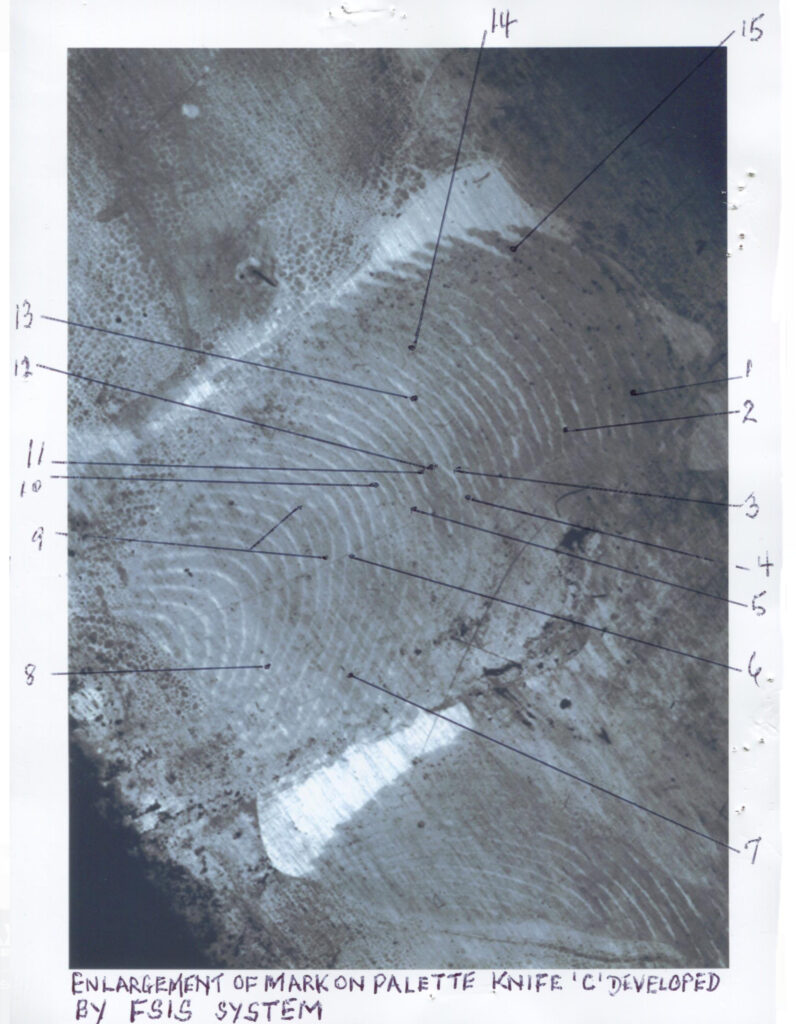
The results were highly encouraging. On three of the cans, fingermarks of varying quality were imaged by the FSIS, yet immediately post fire no visible marks had been present on any of the cans. On five of the palette knives, again, fingermarks of varying quality were imaged by the FSIS. The clear fingermark, which had been seen and photographed immediately post fire on one of the knives, was greatly improved in quality by the application of the FSIS. So the FSIS revealed a further four fingermarks which had not been visible immediately post fire.
It can be taken that the application of Forenteq’s FSIS did produce several additional fingermarks which were not visible immediate post fire, and greatly improved the quality of the clear mark on one of the palette knives.
This was Forenteq’s first application of their FSIS on articles which had been subjected to fire and fire suppression conditions, so provides an additional source of potential development of fingermarks on articles retrieved from arson scenes.
The following are examples of two fingermarks produced by the application of the FSIS. As regards the mark on can ‘D’ by the FSIS, the area in which the can was located during the fire reached a temperature 100C. The area in which the palette knife ‘C’ was located reached a temperature of 1000C.
It should be realised that the quality of a fingermark revealed post fire can be affected by several factors. Obviously the exceptionally clear mark on the palette knife is a fingerprint technician’s dream, but the less clear mark on the can is determined by factors such as:
- Was the donor perspiring at the time?
- Did the donor handle the surface of the articles tightly, pressing very hard as he gripped the can?
Nevertheless, a fingermark was revealed on the can. With the avoidance of the above two factors the mark could have been much clearer.
Once again it has been proved fingermarks can survive fire conditions and we also have a new forensic approach via the FSIS.

Jack Deans FFS FCSFS
Fingerprint Consultant
Gardiner Associates Training & Research