
Educational Blog – Teaching inclusive forensic image processing using open-source software (with the added challenge of being a physicist!)
Dr Ian Whittaker, Nottingham Trent University
My day-to-day teaching is in space physics – creating lunar simulant cement, discussing orbital transfer times to Neptune, or having debates about the private space industry. However, like many academics on a Teaching and Scholarship pathway, I enjoy working in an interdisciplinary environment. While most of my current interdisciplinary research collaborations are with the Arts (Animations for teaching resources) and Social Sciences (Developing policy for space debris management), I enjoy teaching across many different science disciplines.
As a new lecturer fresh out of six years of short term postdoc’s, one of my first challenges at NTU was to run workshops on “Image Processing” to Undergraduate Forensic students – something that drove fear into me initially! The cohorts each year have been small and the different latent knowledge they have from physics cohorts influenced my early teaching, keeping it fresh. While having coffee with some of the Forensics staff we discussed sustainable learning and I realised that using Open Source software in these workshops rather than licensed packages was exactly this!
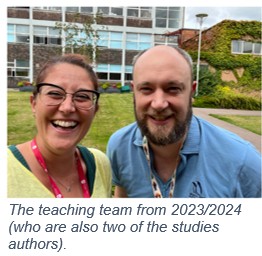
Given the opportunity to write this study (Using open-source software and interdisciplinary teaching to increase digital forensics accessibility, and inclusivity, with sustainable development and learning in higher education) I immediately knew I would need the help of both my Forensics (Rachel Bolton-King and Robyn Adams), Physics (Edward Breeds and Maria-Chiara Roffin), and Mathematics colleagues (Laurence Shaw). I wanted to ensure an accurate student voice so I also enlisted two previous students on the course as well (Joshua Thomson and Megan Dilley-Salter). This allowed me to learn about academic writing in Forensics whilst also providing CPD to the students about academic writing more generally.
We generally see sustainability in teaching as maybe economy of time spent or ensuring resources are available. However, as more of an experimental researcher than theoretical, sustainability to me is a byword for working on a reduced (or zero) budget. A nice example of this is a student co-created Northern Lights simulator we built within a project budget of £100 – whereas a new piece would cost in the region of 20k Euros – achieved by using recycled materials and borrowed equipment.
Open Source software is no different, software licences cost a lot and specific Forensic Image processing programs are limited in their availability to the public (as they should be). This means that it is very hard to teach students what they should be doing when using it if they do not have access outside of the classroom. This study discusses how teaching image processing from the ground up, rather than using set commands, prepares the students to use any software package. It also shows that the use of ImageJ, a free piece of software, allow students to access their work and the software at a time suitable for them – providing increased accessibility to the teaching as well.

Keeping applicability of these ideas interesting is not straight forward of course. Asking students to use images they have taken themselves, and analyse them, brings out ownership of their learning. For example, using a selfie to identify someone in the reflection of their sunglasses, analysing exactly where that celebrities recent social media photo has been airbrushed, or fixing up a still (one prior to the event of course) from the Zapruder film of JFK. These tasks are mixed in with standard approaches like scale measuring of footprints, measuring images of fishing wire samples, and colour corrections using Macbeth charts to create an engaging approach.
Being encouraged to delve into the data and breakdowns of the grade distributions opened up a wealth of information that has since influenced my practice (and hopefully that of others). In a surprise twist it turned out this module was a statistical outlier; in that there was no significant ethnicity gap in the results. We have been very careful within the study to say this could be due to low number statistics of course which is entirely possible but it certainly brought me joy to think that we had a system that worked. Whether this particular result is reproducible or a statistical anomaly unique to us, the students were satisfied with the teaching and are prepared for a job in the competitive world of Forensic Sciences, or any data analysis job as these skills are universal.
If you are interested in any interdisciplinary collaborations (including project students), or would like a non-Forensics seminar speaker then please feel free to email me (ian.whittaker@ntu.ac.uk).
Dr Ian Whittaker is a Senior Lecturer (Teaching and Scholarship) in Physics at Nottingham Trent University. He focuses on developing new ways of bringing physics application to all areas of life and university disciplines – in an attempt to make it less intimidating to the public. He has won a national award for his science communication work with The Conversation (current readership >5.3 million – not that he is bragging), and holds Senior Fellowship of the HEA. Ian was a co-author of the QAA Physics Benchmark statement for 2025.
Please note the contents of this blog represent the views of the author and not the Chartered Society of Forensic Sciences. If you would like to write your own Learning, Teaching or Training blog, please contact Dr Helen Tidy (H.Tidy@tees.ac.uk).
CSFS Educational Blog is available each month to members on the member platform Resource Library