
CSFS Educational blog – April
If it aint broke how do students know how to fix it?
Dr Felicity Carlysle-Davies, Centre for Forensic Science, University of Strathclyde
Who doesn’t love a database? The ability to check the findings of an analysis of an unknown against a known dataset is a key means of identifying that unknown. Students are very happy to rely on a database match, often without much consideration of how reliable the match is and what features of the database could affect the matches.
To try to address some of this I have introduced a database exercise within my teaching of physical evidence types to our MSc class. Rather than just me extolling the virtues (and limitations) of database use in forensic science and the need for increased ground truth datasets, I get the students involved by having them experience the outputs of a badly designed database.
This exercise was first developed during remote teaching so I selected an evidence type that students would have easy access to regardless of their location – fibres. Students are asked to take a homemade tapelift (Sellotape) from a chair or sofa and then input the colour of the fibres seen into a database on our virtual learning environment. They aren’t given any instruction beyond ‘submit the colours of the fibres you have collected’. Unsurprisingly this doesn’t produce a particularly useable or useful bank of data. We review the data collected (figure 1 and figure 2) in a live session where we look at the variety of ways students describe the colour blue and whether data is useful in the form it is presented.
 Figure 1. Raw data exported from the database. The initial version is set with a single field for entry which means some students submit multiple fibre colours in a single database entry.

Figure 2. Extracted data showing the distribution of the fibre colours entered into the first version of the database.
In the first iteration of this activity this was the end of the exercise, but I realised that it would be great to take it a bit further so now students are then tasked with redesigning the database entry form (figure 3). This gets them thinking about what information it is important to capture, how do you maintain the quality of the information, and also how do you want your database to look at the end of it. We use Microsoft Forms to collaboratively create the database entry form in real time and then distribute it amongst the class who then go away and repeat the database entry.
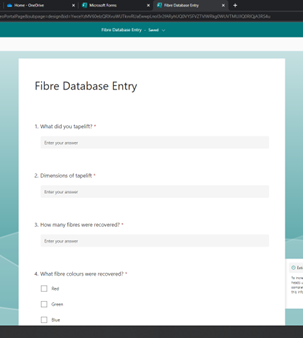
Figure 3. Example database submission form created using Microsoft Forms. This allows real time editing that can be shared with the students during the session.
This is still a bit rough round the edges as an activity, but I really like the basic principle of giving students experience of when something doesn’t work to gain perspective on how to make it better and also a lived understanding of some of the limitations. For future iterations I plan to make it more real time so students would collect the second set of fibres in the lecture theatre. Giving time in the session to not only developing the updated submission form but also use it will hopefully get a higher completion rate on the second database, which has been low up to this point despite good contributions and levels of interaction during the database development. Where the class, as a whole, has produced the updated database, a further option would be to have students work in groups and then compare what they have produced to tease out the key features. There could potentially even be an element of peer evaluation, although I am keen to keep the exercise fairly light touch and not demanding too much time outside of the live session.
This exercise really only scratches the surface, it doesn’t look at matching algorithms for example. Going forward I would like to incorporate more database exemplars and get the students to consider further when and where database use is appropriate. One tool I hope to use with this is the new Foster + Freeman Ground Truth Data Library for Body Fluid Detection which is the first release of their Product Verification Libraries. I’m excited to explore the possibilities of using it as a teaching tool both for body fluid detection but also database use and design.
I’d love to hear suggestions for other good (or bad) database examples, and also if there are any ideas on what to do with the bank of fibre data that I am gradually obtaining!
Dr Felicity Carlysle-Davies is a Teaching Associate at the University of Strathclyde, having previously worked as Coordinator of the Forensic Science Special Interest Group. In her teaching she has a focus on trace evidence and toxicology and is developing a growing interest in education research and increasing inclusivity and accessibility.
Please note the contents of this blog represent the views of the author and not the Chartered Society of Forensic Sciences. If you would like to write your own Learning, Teaching or Training blog, please contact Dr Helen Tidy –H.Tidy@tees.ac.uk
The CSFS Educational blog is available each month to members on the CSFS member platform.